Sugarcane Ethanol and Land Use in Brazil
 A recent study sponsored by the German Marshall Fund and published in Science magazine has cast doubt on the environmental benefits of biofuels, calling attention to its potential negative impact when land-use is factored in the carbon emission equation. The study highlighted only one possible exception: ethanol from Brazilian sugarcane. According to the study, "the extraordinary productivity of Brazilian sugarcane merits special future analysis."
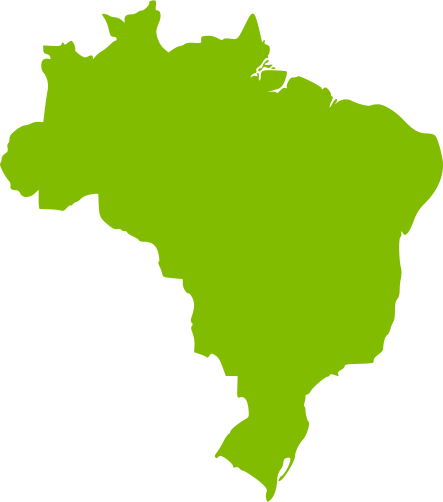
On April 25, as a part of a continuing Brazil Institute series of forums dedicated to biofuels production, economist André Nassar of the Brazilian Institute for International Trade Negotiations (ICONE) presented initial findings of a study on sugarcane expansion and land use in Brazil. Unlike other forms of biofuels, Brazilian ethanol derived from sugarcane does not pose a threat to either global food supplies or the environment, noted Nassar. During the past three decades, Brazil has become the world's fourth largest agricultural exporter while also leading the world in biofuels production. Nassar explained this phenomenon is a result of numerous factors, including the efficiency of sugarcane production and the abundance of available arable and non-forested land. Barbara Bramble of the National Wildlife Federation and Todd Johnson of the World Bank also participated in the discussion.
Speakers
Hosted By
Brazil Institute
The Brazil Institute—the only country-specific policy institution focused on Brazil in Washington—aims to deepen understanding of Brazil’s complex landscape and strengthen relations between Brazilian and US institutions across all sectors. Read more

Environmental Change and Security Program
The Environmental Change and Security Program (ECSP) explores the connections between environmental change, health, and population dynamics and their links to conflict, human insecurity, and foreign policy. Read more

Latin America Program
The Wilson Center’s prestigious Latin America Program provides non-partisan expertise to a broad community of decision makers in the United States and Latin America on critical policy issues facing the Hemisphere. The Program provides insightful and actionable research for policymakers, private sector leaders, journalists, and public intellectuals in the United States and Latin America. To bridge the gap between scholarship and policy action, it fosters new inquiry, sponsors high-level public and private meetings among multiple stakeholders, and explores policy options to improve outcomes for citizens throughout the Americas. Drawing on the Wilson Center’s strength as the nation’s key non-partisan policy forum, the Program serves as a trusted source of analysis and a vital point of contact between the worlds of scholarship and action. Read more